
.png)
The Essential Istanbul Experience: My First Hammam
- Ashtyn Larsen
- Nov 23, 2025
- 4 min read

In the heart of Istanbul's Sultanahmet district, steam rises from marble surfaces that have witnessed centuries of ritual cleansing. For travelers seeking authentic cultural immersion, there's one experience that transcends all typical tourist attractions: the Turkish hammam.

Beyond the Guidebook:
Why Wellness Tourism Matters
One of the many beauties of traveling is your ability to quite literally choose your own adventure. There’s a time to relax on a beach with a cocktail, and there’s a time to immerse oneself in the culture and live as a local. My most profound travel experiences have happened when I’ve surrendered to cultural practices that make me uncomfortable, that initially unsettle me. Wellness tourism—travel focused on maintaining or enhancing personal well-being—offers a unique window into a culture's values and traditions. And especially in Istanbul, that tradition revolves around the spa.
Each country's spa culture tells a story. In Thailand, you remain fully clothed during treatments, wrapped in loose garments while skilled hands work around fabric barriers. Japan's onsen culture represents communal healing through natural hot springs. But Turkey's hammam tradition stands apart—an intimate ritual of cleansing that dates back centuries.
Stepping Into History: Cagaloglu Hamam
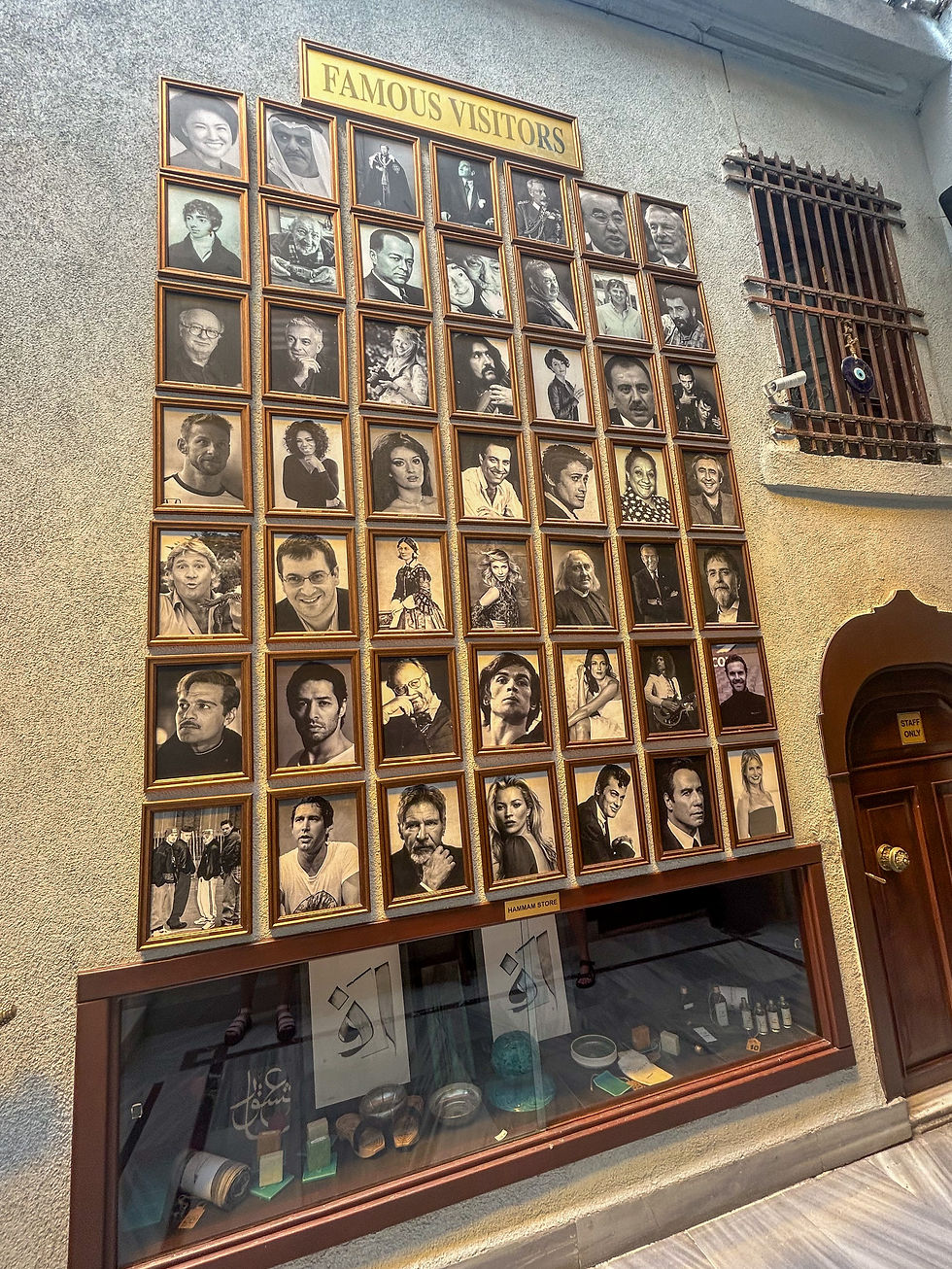
I reserved my appointment at Cagaloglu Hamam, a spa built in 1791 and considered one of the world's most renowned bathhouses. Walking through its entrance, I was greeted by a wall of celebrity photographs. Steve Irwin, Oprah Winfrey, and Cameron Diaz were among the faces smiling back at me who had experienced this same ritual.
The 90-euro, hour-long treatment was an investment in cultural education.
Ottoman-era domes soared overhead, and light streamed through star-shaped openings in the ceiling. It wasn't just a spa; it was a monument to communal wellness that had survived empires and revolutions. The same building embodied beauty, art, and functionality, and I was a grateful blip in the history of an institution.
The Ritual Begins
After checking in, I was escorted to the women's section and to a private changing room.
They handed me towels, disposable underwear, and wooden clogs. These were new to me. It was the first hint that my American notion of privacy was about to be challenged.
Clearly sensing my reticence, an attendant took my hand and led me to the sauna. I sat for fifteen minutes as heat opened my pores and my mind began to quiet. When my time was up, the attendant guided me to the hammam's centerpiece. It was a tremendous circular marble slab called the göbek taşı, heated from below, where women lay prostrate, receiving treatments.

Ancient stones were worn smooth by countless bodies. The steam was dense, and it hung in the air. The atmosphere was ethereal, existing beyond me and outside of time.
The Art of the Hammam
What followed was unlike any spa experience I had ever experienced. Two buckets of water—one hot, one cold—hit the top of my head, drenching me without warning.
I gasped, then giggled, in shock and amusement.
She spread my towel across the heated marble and gestured for me to lie down. What proceeded was methodical yet nurturing: a full-body exfoliation using a rough mitt called a kese, removing layers of dead skin I didn't know existed.

Then came a transformation that made the treatment a form of art. Seemingly from nowhere, enormous bubbles began filling the air around me. I looked on in awe as my attendant dipped a foam bag—similar to a pillowcase—into olive oil soap. She swung it through the air, creating magnificent bubbles that enveloped my entire body.
For twenty minutes, I was massaged beneath this cloud of soap bubbles. I felt my skin becoming impossibly soft. It felt both ancient and otherworldly, this ritual passed down through generations and unlike anything in my American frame of reference.
Embracing the Unfamiliar
The conclusion was equally ceremonial. My hair was washed, a final rinse, and I was wrapped in warm towels before being led back to the foyer where Turkish coffee and delight awaited. Every gesture was intentional, and every movement was steeped in tradition.
This experience embodied what I've come to value most about travel. It was a productive culture shock. Though that term generates a certain level of negative displacement, this culture shock was built on exhilarating anxiety that comes from encountering something completely foreign to your experience. I emerged grateful beyond words to have experienced it.
Was I nervous about strangers bathing me while other women lay nearby? I was. In American culture, bathing is intensely private. But this discomfort was precisely what made the experience valuable. It forced me to question my assumptions about the body, community, and care.
The Deeper Journey
Travel, at its best, provides experiences that reshape our understanding of normalcy. The hammam reminded me why I seek out wellness experiences across cultures. They reveal how different societies approach the fundamental human needs for cleansing, healing, and community. In Thailand's clothed treatments, I experienced modesty and discretion. In Turkey's hammam, I discovered the power of vulnerability and trust.
As I left Cagaloglu Hamam, skin glowing and spirit renewed, I understood why this ritual has endured for centuries.
In a world increasingly focused on individual wellness, the hammam offers something radical: communal care administered by skilled hands in a space designed for collective healing.
This was my first hammam, but I'm certain it won't be my last. Some experiences are worth repeating, not despite their foreignness, but because of it.


Comments